Throughout the United States regulatory requirements at state and federal levels regarding the discharge of wastewater from all types of manufacturing facilities that generate wastewater that discharge any sort of effluent into sewer systems, lakes, rivers or the ocean is required to neutralize this effluent before discharge. The result of noncompliance can be financial penalties, at a minimum, and can include other consequences such as remediation due to any environmental damage. It is in the best interest of any company and may be compulsory to log and report effluent characteristics such as pH at the plant discharge point.
pH Monitoring and Neutralization Systems
Automatic pH neutralization systems monitor and control effluent pH by caustic and/or acid addition. A simple pH neutralization system includes five subsystems:
- Reaction tank with mixer or mixing pump or skid-based injection, inline mixing prior to a large treatment tank.
- pH sensor
- pH controller or PLC/HMI system for monitoring, pump control and recording
- Chemical reagent storage tanks
- Chemical injection pump(s)
In this system, effluent flows into the reaction tank where a pH sensor measures the pH of the fluid. A pH controller or PLC holds a pH set point for the effluent to match and uses this value to determine whether or not the effluent is attaining that set point. If not the chemical pump(s) inject caustic or acid solutions as required to bring the effluent in the reaction tank to the correct pH. The mixer assures thorough mixing of the injected chemical with the tank volume and the pH sensor receives a proper sample of the pH level at its location.
Monitoring pH Neutralization Results
pH neutralization can be implemented in batch or continuous mode, either way there will be a regular or intermittent discharge. Monitoring of this discharge is required to verify its pH level prior to final release outside the plant. To monitor this flow a pH sensor needs to be located after the neutralization system either inline in the discharge piping or in a final check tank that the neutralization tank feeds into.
This monitoring results in continuous datalogging and reporting of the pH. Reporting can be as simple as a spreadsheet of logged points or a fully formatted and graphed report as required by plant administration or local POTW authorities. The Intell-i-Watch system provides a delimited log in CSV format (a TXT file) and spreadsheet in XLS form for your use in reporting the logged data. This data can then be inserted into your report. Being a delimited file type, the CSV data can be imported into a database, spreadsheets, and mail merged with a variety of documents. Some CRM programs support dataset creation with CSVs. When using XLS type spreadsheets you can graph data points for examples, figures and explanations.
If desired you can also setup Excel to replay or scroll your data graphs via “REPT” or other utilities.
Review data on screen
The Intell-i-Watch system provides on screen real-time and historical review of your data. This data can be called up and graph run to show your pH readings over time and select points in time.
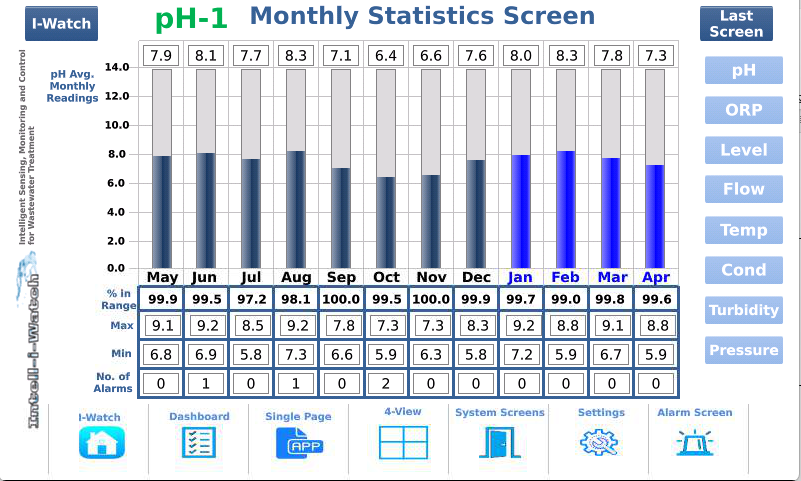
We also provide a Calculations & Statistics Screen that continuously breaks down and organizes each of your channels data types (in this case pH) and automatically presents the following so you don’t have to.
Monthly
- % of readings in range (based on high & low pH range set by you)
- Minimum reading
- Maximum reading
- Number of alarms (alarms trip outside your established range)
- Graphical representation of the logged data
Common Neutralization System Problems
In many industrial plants, maintenance of wastewater treatment equipment can be a key challenge. In these plants, wastewater is often a source of cost as opposed to a revenue source and therefore does not receive the maintenance resources like the rest of the facility. Poorly operating pH measurement systems can lead to out of spec neutralization. In these cases, manual override of dosing systems is a common practice, and costly overdosing with correction chemicals can occur.
Many operational problems in a pH neutralization system are related to pH sensor condition and performance, with incorrect choice of electrode technology and placement being common causes. pH sensor selection and care are a key element in stress free operation.
Additional thoughts
With the plethora of sensors and monitoring system available in the marketplace the Intell-i-Watch offers a simple device that can provide more horsepower than most systems allowing you to automate many monitoring functions. Study the subject matter and contact Pan America Environmental with any questions you may have for integration with our Intell-i-Watch systems.

Intell-i-Watch multi-sensor transmitter monitoring systems are designed and supported by Pan America Environmental, Inc., with over 35 years of experience in industrial water and wastewater treatment.